We Built the Wrong Thing. Then 40 Conversations Lead To A Sales ‘Dark Factory’.
By Cameron Drake and Santiago Arias, co-founders of Celoia
I have spent ten years in founding sales. I neglected CRM fields, missed call details in proposals, wrote countless follow-ups (personalized, time permitting), and lost deals because backlogged to-do's didn't get done in time.
Santiago and I started Celoia in January to automate the important, detail oriented sales work humans naturally miss. We started narrow, but 40 conversations with real sales operators rebuilt the product under our feet, and the buyers themselves named what we were supposed to be building before we did.
What we built first: screen capture and CRM updates
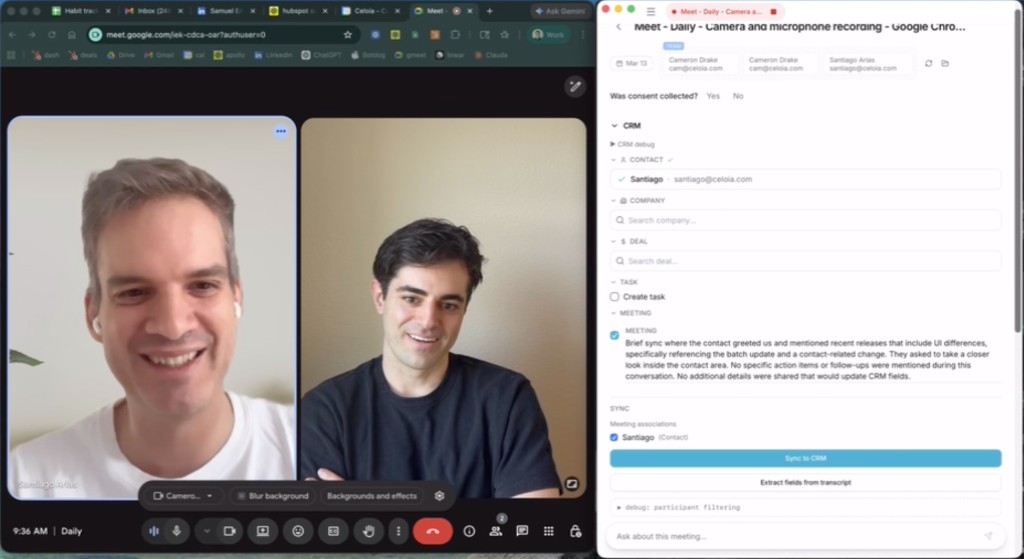
The first version of Celoia transcribed conversations, captured LinkedIn messages, matched the activity to your contacts, and proposed CRM updates. It worked. It made keeping CRM updated fast and easy. But people didn't want another notetaker. They had bigger problems than sales hygiene.
Celoia v0 was too narrow.
What we heard: activity capture is solved. The work around it isn't.
On January 26 we got on a call with the head of biz dev at a high-growth analytics company. He had Gong, Clay, Outreach, and Sales Nav already. He watched the demo and said, "it seems pretty redundant to our current data stack."
Three days earlier, a Sales Ops lead at a mid-market financial services platform had pointed at the actual gap. Their hygiene was already under control. What he said was: "We haven't really solved for the executive layer at all, because they can't consume it. They need red, yellow, green lights on all 9,000 accounts."
The pattern was consistent. They didn't have a way to reliably turn historical, multi-tool activity data into reliable action. Action that requires time: forecast updates, deal research, meeting briefs, follow-ups, question routing, renewal flags, coaching, CS handoff, team approvals. Customer information and work-to-be-done existed already, just floating between apps, in people's heads, left to be pieced together late on a Friday.
We needed to solve for the work, not the capture.
What we heard next: workflows are too brittle. AI is too rogue.
When we asked buyers what they'd already tried, two patterns came up.
The first was workflow tools. n8n, Zapier, internal scripts. A few build their own workflow stack: Gong's API, n8n, Replit, Sheets, the works. The pattern across calls was the same: workflow tools handle "if this, then that" reliably, but every edge case needs a new branch. Every rep, a new workflow copy. Some adopted, most didn't. As workflows built up in complexity and quantity, they started to break and require maintenance and clean up.
The second was Claude, ChatGPT, and other freeform AI agents. A founding BDM at a Series A startup put it the way most people feel it: "I'm tired of putting 'please do not hallucinate' on all of my prompts. And still having to fact check." Claude is a flexible tool, but it makes stuff up, improvises with unsanctioned actions, burns credits, cuts corners, and requires constant prompting, guidance, and correction. Trust collapses fast, time savings are negligible.
Buyers were caught between two bad options. Brittle workflows that don't easily handle edge cases. Rogue AI that doesn't inspire trust. Neither reliably handles customer work end-to-end without consistent human intervention.
The vision: a dark factory of revenue agents
A workflow is like a factory line producing many copies of the same car model. Each worker's skills and tools are specialized to make their productivity fast and consistent. Great for economies of scale, but with more trim package and color variations, more production line breakdowns, mistakes, and backlogged order buildups.
A generic AI agent is like a custom car mechanic. Each build is different from the last. Even if their skills and workshop are refined, they're running around the shop, trying to fit pieces together, and inevitably hitting snags. Because AI orders are due in 10 seconds, don't be surprised to find some duct tape under the hood.
There's a concept in manufacturing called a dark factory: a facility automated enough to run with next to zero human intervention. Machines don't need the lights on. A factory where each step is automated and specialized, but smart enough to adapt to variance and custom builds. The factory line adapts to each custom order. Humans are just there to sign-off on the final products.
Our vision is a dark factory for sales orgs.
What we built: playbooks. Flexibility of agents, reliability of workflows.
A playbook is a workflow, uniquely adapted to sales work-to-be-done for every customer, prospect, and deal. Celoia deploys a factory of the specialized subagents, each with the right skills and tools, forming an appropriate production line. They replicate a natural, thoughtful sales workflow:
- A trigger fires. A discovery call ended. A deal stalled for seven days. A contract got signed. A renewal is 60 days out. A churn signal hit.
- Research the full history of the customer or deal. Who said what, when, and why. Across every channel and app where activity actually happened. Find the customer signals and details that need action.
- Pick skills and adapt the work. Find the relevant testimonial. Draft the follow-up email. Update CRM fields. Pull deal history. Score the call against MEDDPIC. Route an internal question to legal. Build a deck.
- Check quality, get approval, push. Every output lands in the human approver's queue. Each drafted work proposal comes with source evidence and logic. Each approved action is deterministic, meaning it's coded to execute in your apps exactly as proposed.
Playbook · flow
How a Celoia playbook runs
From signal to approved work, steps adapt to each customer.
- Discovery call ended
- No reply for 7 days
- Contract signed
- Renewal in 60 days
- Churn signal hit
- Call transcripts
- Email + Slack threads
- CRM + support tickets
- Calendar + docs
- Unintegrated messages
- Find a case study
- Draft follow-up email
- Update CRM fields
- Score against MEDDPIC
- Route to legal
- Evidence + sources shown
- Logic surfaced
- Assigned approver gate
- Low-risk auto-runs
- Deterministic app write
Skills are flexible inside their place on the playbook factory line. The playbook steps adapt to the situation, but the inputs and outputs are reliable as in a workflow. Low-risk steps run automatically. Sensitive actions never ship without a human confirming.
This is Santiago's framing of the architecture, almost verbatim from a call on April 24: "The LLMs only explore. They don't write. They explore and then they propose an idea. Once that idea gets approved, there's no more AI. It just calls deterministic code that executes the step before moving onto the next. So there's no hallucination or improvisation possible. What you see is what you get."
The efficiency and reliability of a production line, the adaptiveness of a custom car mechanic, and the hands-off nature of a dark factory. A CSM watched a playbook step run in March and put it in simpler terms, "It's like, between Zapier and Claude but for sales."
However you want to describe it, it's a game changer. Celoia helps sales orgs get 20x more done, without sacrificing quality.
Apply to join the beta
We're letting in a small group of customers to pilot the Celoia beta. If you have a sales team of five or more, need to improve team process speed and consistency, and you've thought "this should already be done by now" more than once this week, we'd like to talk.
Schedule a 30-minute call to discuss your hardest workflows. If it's a fit, we build the first playbook for you and put a fleet of revenue agents to work.
Cameron Drake and Santiago Arias are the co-founders of Celoia. Cam is a 2x founder and 3x founding GTM at manufacturing and B2B SaaS startups. Santiago was the founding CTO at Chili Piper and a founding engineer at HockeyStack.